The Hem-to-Shoe Gap Decides Your Leg Line More Than the Pants Do
Quick Answer: The eye reads a leg as long when the line from hip to foot is continuous. A gap of bare skin or contrasting sock between your hem and your shoe interrupts that line and visually shortens the leg — unless the gap is large enough to read as a deliberate ankle, roughly three inches or more. Either close the gap completely or open it clearly. The in-between is what shortens you.
You have the high-rise trousers. You have the pointed shoes. Something still reads slightly off in photos.
Look at the two inches between your hem and your shoe, because that is almost always where the length went.
What is the gap actually doing to the line?
It is inserting a horizontal break at the worst possible point.
The eye follows continuous lines and stops at interruptions. A leg line runs from the waistband down to the floor. Any strong horizontal contrast along that run acts as a stop, and the eye measures the segment it stopped at rather than the whole.
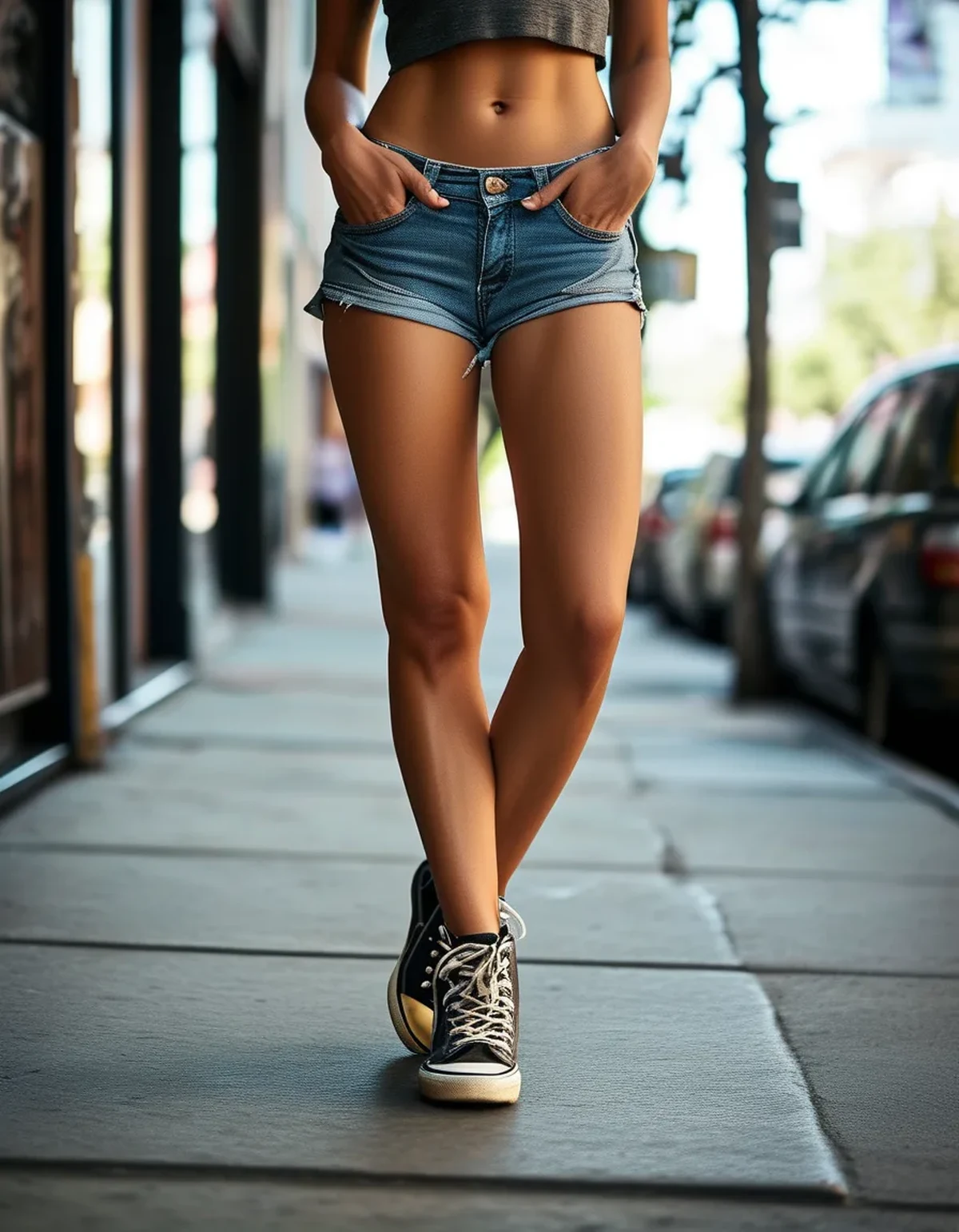
A small gap reads as an accident. One to two inches of skin or sock between hem and shoe does not read as an ankle — it reads as a mistake in hemming. The eye registers it as a break without any compensating benefit, so you get the shortening without the elegance.
A large gap reads as intent. Three inches or more of visible ankle is a recognizable proportion. The eye reads it as a deliberate cropped length, and the exposed ankle is narrow enough that it does not create a heavy break.
Zero gap reads as longest. A hem that just meets the shoe, with matched or close tones, produces the most continuous line available. This is why full-length trousers over a matching shoe is the reliable answer in almost every proportion guide.
The rule that falls out of this: commit in one direction. The failure mode is always the middle.
How does color change the same gap?
Enormously — enough to turn a bad gap into a good one without changing a single garment length.
Contrast is what makes a break visible. A dark trouser over a dark shoe with a small gap of pale skin creates maximum contrast at exactly the wrong point. The same trouser over a shoe in a similar tone, with a sock that matches either, nearly erases the break.
Match the sock to the trouser, not the shoe. This extends the leg line downward. A sock matching the shoe extends the shoe upward, which shortens the leg. This single swap is the cheapest fix available and it is the one people get backwards most often.
Nude-to-you shoes work by removing the break entirely. A shoe close to your own skin tone reads as a continuation of the leg rather than a separate object. This is why the trick works so well and why a shoe two shades off does not work at all.
Bare ankle in a warm season is a genuine option, provided the gap is large enough to be deliberate. In cooler months the same gap with a contrasting sock is the version that goes wrong.
Late summer note: as you move into closed shoes and socks in September, the gap that worked barefoot in August becomes a contrast break. This is why outfits that felt long in July suddenly do not in the fall.

Myth vs Fact: Hems, Shoes, and Leg Line
Myth: Cropped pants always shorten your legs. Fact: Cropped pants shorten your legs when the crop lands at the widest part of the calf or leaves an ambiguous gap. A crop that lands at the narrowest point of the ankle, worn with a low-profile shoe, frequently lengthens.
Myth: Longer is always better. Fact: A hem that pools on the ground creates horizontal folds and hides the foot, which shortens the visible line and reads as sloppy. The target is skimming the top of the shoe, not covering it.
Myth: Heels solve everything. Fact: Heels help, but a heel with a strong contrast break at the ankle gains less than a flat with a continuous line. The break costs more than the heel adds — which is the third fact that genuinely surprises people.
Myth: Ankle straps are just a detail. Fact: An ankle strap draws a horizontal line at the exact narrowest point of your leg, which is the most effective place to cut it. Beautiful shoes, and they cost you visual length every time.
Myth: This only matters if you are short. Fact: Proportion is relative, not absolute. The same break shortens the visible leg line on anyone — tall people simply have more length to spare.
How do you fix it with what you already own?
Five adjustments, none of which require buying anything.
Decide which direction each pair goes. Look at each pair of trousers and decide: is this a full-length pair (hem skims the shoe) or a deliberate crop (three-plus inches of ankle)? Anything currently in the middle needs hemming or a different shoe.
Change the shoe before you change the pants. A lower-profile shoe, or one closer to the trouser tone, closes a gap that a hem cannot reach. A pair that fails with white sneakers often works perfectly with a low black shoe.
Swap the sock color. Trouser-matched socks, not shoe-matched. Free, and it changes photos noticeably.
Watch your sock height. A crew sock in a matching tone extends the line; a low ankle sock creates a small break at the narrowest point. This is why crew socks have quietly become the styling default rather than a trend.
Check it seated, too. Trousers ride up when you sit, which turns a full-length pair into an accidental crop with a bad gap. If most of your photos are seated, choose lengths with that in mind.
And check in a full-length mirror from six feet back. Proportion problems are invisible at arm’s length and obvious from across a room, which is exactly the distance other people see you from.
FAQ: Hem and Leg Line Questions, Answered
What is the ideal trouser length?
For a continuous line, the hem should just touch the top of the shoe with a very slight break — no pooling, no visible gap when standing. For a deliberate crop, aim for the narrowest point of the ankle, which for most people is roughly an inch or two above the ankle bone. Anything between those two is the zone to avoid.
Do leggings follow the same rules?
Yes, and more strictly, because a legging already provides a perfectly continuous line — a contrasting sock or a chunky shoe interrupts something that was otherwise seamless. Full-length leggings into a low, tonal shoe is one of the longest lines available in any wardrobe.
Does this change with wide-leg pants?
The principle holds but the tolerance is smaller. Wide legs hide the ankle, so the hem needs to be long enough to maintain the column — a wide-leg crop with a gap creates a wide horizontal shape right where you least want one. With wide legs, go long or go clearly cropped with a narrow shoe.
TL;DR:
- A one-to-two-inch gap between hem and shoe is the worst option — it breaks the line without reading as intentional
- Commit in one direction: hem skimming the shoe, or three-plus inches of deliberate ankle
- Match socks to the trouser, never to the shoe, and use crew height over ankle height
- Changing the shoe often fixes a pair that a hem cannot reach
The pants were never the problem. The two inches above your shoe were doing all the work, in the wrong direction.
See It in Motion
Seen here: High Waist 8” Yoga Shorts — shop similar styles on bubblelime.com
Keep Reading
This article is for general informational and styling purposes only. Fit, sizing, and product availability may vary — check current details before purchasing.