Why Ankle Boots Cut the Leg Line — and the Fix
Quick Answer: Ankle boots shorten the leg when the shaft ends at the widest part of your calf or leaves a gap of bare skin between hem and boot. Matching the boot color to your hem and keeping the shaft below the calf swell fixes most of it.
Boot season arrives and suddenly outfits that worked in sandals look off. Same trousers, same proportions, legs that read noticeably shorter.
The boots didn’t change your legs. They added a horizontal line, and horizontal lines are where leg length is won or lost.

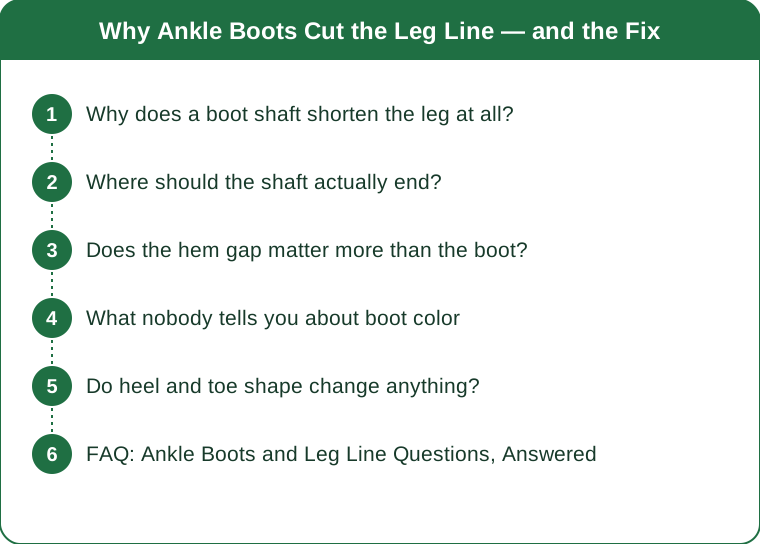
Why does a boot shaft shorten the leg at all?
Your eye reads leg length as one continuous vertical run. Anything that crosses it horizontally divides that run into segments, and you perceive the longest single segment rather than the total.
An ankle boot puts a hard line somewhere between your ankle bone and mid-calf. If that line lands at the widest point of your calf, it does two things at once: it breaks the vertical, and it marks the break at the visually heaviest point.
A taller knee boot doesn’t do this because the shaft continues the line upward. A low sneaker doesn’t either, because it sits below the ankle where the leg is already tapering out of view. The ankle boot lands in the worst possible zone.
Where should the shaft actually end?
The reliable rule is below the calf swell, not above it. For most people that’s within 2-3 cm above the ankle bone.
Here’s how to find yours: stand barefoot, run a hand up your calf, and note where it starts widening. A shaft that ends below that point keeps the widening part of your leg uninterrupted. A shaft that ends at or just above it stamps a line right where your leg is thickest.
The common mistake is buying a shaft in the 10-13 cm range without checking it against your own calf. On a shorter leg, 13 cm can land mid-calf. On a longer one, the same boot sits low and clean. The number on the box means nothing without your leg attached to it.
Does the hem gap matter more than the boot?
Often, yes. A gap of bare skin or sock between your hem and your boot creates a second horizontal line, and now you’ve divided the leg twice instead of once.
The fixes, in order of how much they help:
- Close the gap entirely. Hem should touch or slightly break on the boot. This is the single biggest change you can make.
- Match the tones. If a gap is unavoidable, a sock or tight in the same value as either the trouser or the boot softens the line into near-invisibility.
- Go longer, not shorter. A hem that stacks slightly on the boot reads as continuous. A hem that hovers 4 cm above it reads as a broken column.
Cropped trousers with ankle boots are the classic trap: they guarantee both a gap and a mid-calf line.

What nobody tells you about boot color
Everyone knows matching shoe to hem lengthens the leg. Almost nobody applies it correctly to boots, because the boot has more surface area than a shoe and the mismatch costs more.
A black ankle boot under black trousers extends the column all the way to the floor — the break essentially disappears. That same black boot under camel trousers puts a dark block at the bottom of a light leg, and the eye stops there.
The practical version: your boot should match your hem, or your hem should be darker than your boot. Light hem over dark boot is the combination that shortens most, and it’s also the one people reach for first in fall because dark boots feel like the safe purchase.
If you own one pair of boots and many trouser colors, a mid-tone that sits close to several of them beats black.
Do heel and toe shape change anything?
Less than shaft height, but they’re not nothing.
Toe shape controls the visual runway at the end of the leg. A slightly elongated or almond toe adds a centimeter or two of continuation. A hard round or squared-off toe stops the line abruptly.
Heel height matters mostly through what it does to your hem. A 5 cm heel raises your hem off the ground, which can open a gap that wasn’t there in flats — so a trouser hemmed for boots is a different length than one hemmed for sneakers.
If you wear both, hem for the boots and accept a slightly longer line in flats. The reverse — hemming for flats and wearing boots — is what creates the floating hem you see everywhere in October.
FAQ: Ankle Boots and Leg Line Questions, Answered
Do pointed-toe ankle boots really lengthen legs?
Modestly. The point adds visual length past the foot, worth maybe a centimeter or two of perceived line. It’s a genuine effect but far smaller than fixing shaft height or closing a hem gap — do those first.
What about ankle boots with skirts and dresses?
The same rule applies but the stakes are higher, since more of your leg is visible. Keep the shaft below the calf swell and match your tights to the boot rather than the skirt. A bare leg between a skirt hem and a dark boot creates the strongest break of any combination.
Are wide-shaft boots worse than fitted ones?
Usually, yes. A wide shaft adds visual width at the ankle, which is normally the narrowest point of your leg and the thing that makes the calf above it read as tapered. Losing that taper flattens the whole lower leg.
TL;DR:
- Ankle boots break the vertical line of the leg; where they break it decides everything.
- Keep the shaft below where your calf starts widening — measure on your own leg, not by the boot’s stated height.
- Close the hem-to-boot gap. That single fix outperforms toe shape, heel height, and shaft style combined.
- Match boot to hem, or keep the hem darker than the boot.
Boot season doesn’t have to cost you two inches of leg. Once you know the line is the problem, you can buy for shaft height and hem length instead of hoping a pair works out.
See It in Motion
Seen here: High Waist Drawstring Wide Leg Yoga Pants with Pockets — shop it on bubblelime.com
Keep Reading
This article is for general informational and styling purposes only. Fit, sizing, and product availability may vary — check current details before purchasing.