Why High-Rise Does Not Always Make Your Legs Look Longer
Quick Answer: A high rise creates the appearance of longer legs by moving the visual break between torso and leg upward. It only works if that break stays visible, which means the waistline has to be defined by a tuck, a crop, a belt, or a colour change. Cover the waistline with an untucked top and you have removed the mechanism entirely, which is why high-rise jeans under a long shirt do nothing. Two other conditions matter: the leg line below must be unbroken, and the rise has to sit at your actual natural waist rather than above or below it.
High-rise lengthens your legs. Everyone knows this, and everyone has also owned a pair of high-rise trousers that did nothing at all.
The rule is not wrong. It has three conditions attached, and most outfits satisfy one of them.
How does high-rise create the effect at all?
It moves where the eye reads the leg as beginning.
When the eye scans a figure, it registers the horizontal division between torso and legs at the most visible break. That break is usually the waistband, a hem, or a colour change.
Raise that break and the legs appear to make up a larger share of your total height. Nothing about your body has changed. The proportion being read has.
Which leads directly to the condition everyone misses: if the eye cannot see the break, there is no break to read. The waistband being high does nothing if it is hidden.
This is the single reason most high-rise outfits fail. High-rise jeans plus a long untucked sweater puts the visible break at the sweater hem, which is at the hip or lower. The eye reads a shorter leg than the mid-rise jeans with a tucked shirt would have produced.
The mechanism in one sentence: high-rise is not a leg-lengthener, it is a waist-position tool, and the waist position has to be visible to count.
What are the three conditions?
Condition 1, the waistline must be visible. Achieved by any of:
- Tucking the top in fully, the strongest version
- A cropped top ending at or above the waistband
- A front tuck or half tuck, weaker but effective
- A belt in a contrasting or matching tone that draws the eye to the line
- A top in a clearly different colour, so the break reads even untucked, as long as the hem is at the waistband
Condition 2, the leg line below must be unbroken. A high waist puts a longer visual leg on the page, and horizontal interruptions cut it back up:
- Cropped hems that end mid-calf shorten the line
- Contrasting shoes create a hard stop at the ankle. Shoes closer to your trouser colour or your skin tone continue it.
- Cuffs, ankle straps, and contrast socks all interrupt
- Bulk at the ankle, whether from a wide crop or a chunky boot shaft, stops the eye
Condition 3, the rise must match your natural waist. This is the one that varies by body:
- A rise that sits above your natural waist compresses your ribcage visually, looks unbalanced, and is uncomfortable
- A rise sold as high that lands at your mid-hip on a long torso is functionally a mid-rise, and it will behave like one
- Long torsos frequently need a higher rise than the label suggests to reach the natural waist, and this is the most common reason high-rise disappoints someone. If high-rise never seems to work on you, measure your rise against your torso rather than trying a different brand.

5 Mistakes That Cancel the Effect
1. The long untucked top. The most common one, covered above. You have moved the waistband up and left the visible break at the sweater hem. Net effect zero, or negative.
2. Contrast shoes with a crop. High-rise cropped trousers with a white sneaker creates two horizontal breaks close together at the shortest part of the leg. This is the outfit that people find inexplicably shortening.
3. Belting below the natural waist. A belt worn on the hip over a high rise contradicts the rise, and the belt wins because it is the more visible line.
4. Over-tucking a voluminous top. A large amount of fabric tucked in creates bulk at the waist, which widens the visual break and blurs the line. A tuck works when it is clean. Try a French tuck at the front only, or a thinner top.
5. Assuming the rise measurement is comparable across brands. Front rise measurements vary by several centimetres between brands at the same nominal label. Compare the actual measurement, usually listed in the product details, rather than the word.
The one adjustment worth more than any of the above: match your shoe tone to your trouser hem or to your skin. It continues the line rather than terminating it, and it works whether or not the rise is high. On a bare-leg outfit, a nude-to-your-skin shoe is the strongest lengthening tool available.
Late-summer note: this is the season where the mistake happens most, because the transitional outfit of the moment is a long lightweight overshirt or cardigan over high-rise trousers. It is comfortable and it hides the waistline completely. If you want the proportion back, either tuck the layer underneath and leave the overshirt open, which restores a visible vertical line, or belt over the top layer at your natural waist.
What works if high-rise is not comfortable?
Plenty, because the waistline break is the mechanism, not the rise itself.
Mid-rise with a tucked top and a matched belt produces much of the effect, since the visible break is what matters and a mid-rise waistband is still above your hip.
A monochrome column works independently of rise. Same or similar tone from shoulder to shoe means no horizontal break anywhere, which reads as unbroken height. This is the most reliable lengthening technique available and it does not care where your waistband sits.
Vertical detail does real work. A centre front seam, a pressed crease down the leg, a long open cardigan or blazer creating two vertical lines, a narrow scarf hanging long.
Hem length at the right point. A full-length trouser breaking just at the top of the shoe foot is the longest-reading hem. Too short interrupts at the ankle; too long puddles and breaks the line.
A slight heel, even 3cm, adds length and changes posture, which lengthens more than the height alone accounts for.
For long torsos specifically, which is where high-rise most often disappoints: prioritize the tuck and the belt over the rise number, wear the belt at your actual natural waist even if that is above the waistband, and consider bottoms with a wider waistband, which visually raises the break by a couple of centimetres.
And a reminder that runs against most of this advice: none of this is obligatory. Proportion tools are useful when you want a particular line, and an untucked oversized shirt over high-rise trousers is a perfectly good outfit that simply is not doing a lengthening job. Knowing which you are wearing is the useful part.
FAQ: High-Rise Proportion Questions, Answered
Does high-rise really make your legs look longer?
Only when the waistline is visible. High-rise moves the visual break between torso and legs upward, and covering it with an untucked top removes the mechanism entirely.
Why does high-rise not work on me?
Most often the rise is not reaching your natural waist, which is common with a long torso, or the outfit is hiding the waistline. Measure the front rise against your own torso rather than trusting the label.
What lengthens legs more than high-rise?
A monochrome column from shoulder to shoe, and matching your shoe tone to your hem or skin. Both work regardless of rise, because they remove horizontal breaks rather than moving one.
TL;DR:
- High-rise works by moving the visible break between torso and leg upward. Hide the waistline and the effect disappears.
- Three conditions: visible waistline, unbroken leg line below, and a rise that reaches your actual natural waist.
- Contrast shoes with a cropped hem is the outfit that shortens most, because it creates two breaks at the narrowest part of the leg.
- Matching shoe tone to hem or skin, and a monochrome column, both work better than rise alone.
If high-rise has never worked for you, measure the front rise against your torso before you blame the trousers.
See It in Motion
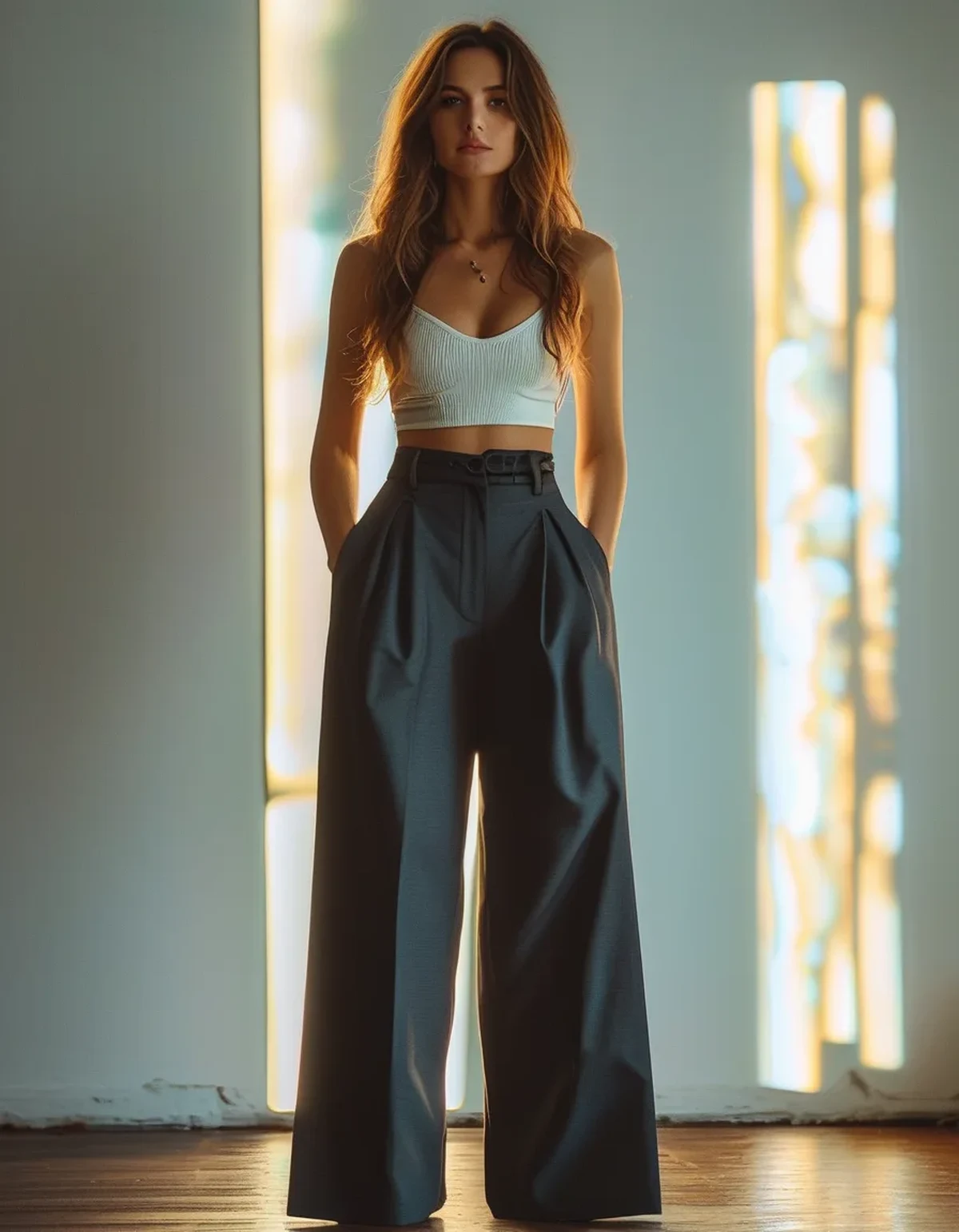
Seen here: High Waist Wide Leg Yoga Pants with Pockets — shop it on bubblelime.com
Keep Reading
This article is for general informational and styling purposes only. Fit, sizing, and product availability may vary — check current details before purchasing.